|
Historic St. Mary’s City, Maryland
Website: http://www.stmaryscity.org
Historic St. Mary’s City
was Maryland’s first settlement (the 4th
permanent settlement in British North America) and for
61 years its colonial capital. After the capital was
moved to Annapolis in 1795, St. Mary’s City was
virtually abandoned and eventually converted to
agricultural use. Today, Historic St. Mary’s City is an
outdoor museum and archeological park on the site of
Maryland’s original settlement. With emphasis on the 17th
century, the St. Mary’s City Commission studies the
history of St. Mary’s City, preserves its archeological
evidence, and interprets that history for the public.
Geography and History
 At a
site on the St. Mary’s River, the Yaocomaco Indians had
already cleared land but were preparing to leave,
possibly due to hostilities with the Susquehannock. The
land was claimed in the name of King Charles I and Lord
Baltimore and was called Saint Maries in honor of the
Virgin Mary. In 1668, to encourage development, Lord
Baltimore chartered St. Mary's City. Today, everything
that once stood on the 17th-century town lands has
disappeared-at least above ground. St. Mary's City was
abandoned for the present Maryland capital of Annapolis
in 1695. Fortunately, there was very little later
development to destroy the site of what was once the
first capital. At a
site on the St. Mary’s River, the Yaocomaco Indians had
already cleared land but were preparing to leave,
possibly due to hostilities with the Susquehannock. The
land was claimed in the name of King Charles I and Lord
Baltimore and was called Saint Maries in honor of the
Virgin Mary. In 1668, to encourage development, Lord
Baltimore chartered St. Mary's City. Today, everything
that once stood on the 17th-century town lands has
disappeared-at least above ground. St. Mary's City was
abandoned for the present Maryland capital of Annapolis
in 1695. Fortunately, there was very little later
development to destroy the site of what was once the
first capital.
Archeology and Public
Interpretation
The
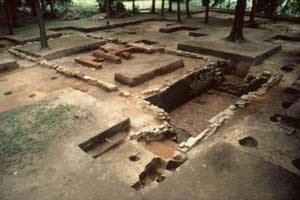
Archeology program at Historic St. Mary's City has been
ongoing since 1971 when the museum hired its first staff
archeologist. Archeologists have recorded over three
hundred archeological sites within the limits of the
National Landmark. Historic St. Mary's City has
co-sponsored with St. Mary's College of Maryland
one of the longest running field schools in historical
archeology in the United States. The
museum is the heart of a National Historic Landmark
recognized as one of America's best-preserved colonial
archeology sites.
Current research
projects range from analysis of 18th-century deposits on
the college campus to excavations at the site where
William Nuthead operated the first printing press in the
English colonies south of Massachusetts. Past research
projects range from site intensive excavations through
site surveys and include the excavations at Brick Chapel
of 1667 and the examination of three lead coffins found
in the Chapel. Building on this research, St. Mary’s
City offers a number of guided tours for school groups
and adult visitors as well as an extensive online
virtual tour of the entire museum complex, including its
history and archeology.
At Historic St. Mary's
City, colorful costumed interpreters in recreated
17th-century settings tell the stories of Maryland's
first years, when St. Mary's was the state capital.
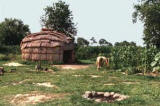
Outdoor exhibits feature a reconstructed State House of
1676, a working colonial farm, the Woodland Indian
Hamlet, and the Maryland Dove, a replica square-rigged
ship. Hands-on activities are offered at most sites
where visitors encounter special opportunities to work
alongside professional archeologists, churn butter,
watch a militia drill, or shoot a bow and arrow.
|