|
Jefferson Patterson Park & Museum, Maryland
Website:
http://www.jefpat.org
Located just 45 minutes
south of the Washington Capital Beltway in Calvert
County, Maryland, Jefferson Patterson Park and Museum is
a state history and archeology museum exploring the
changing cultures and environment of the Chesapeake Bay
region of the past 12,000 years. The park and museum are
part of the State of Maryland’s
Historical Trust agency.
Geography and History
 Jefferson
Patterson Park and Museum is a 544-acre park located
along 2.5 miles of the Patuxtent River and St. Leonard
Creek in Calvert County, Maryland. Archeological surveys
of the property have revealed over 70 sites spanning
9,000 years of human history. Research also has revealed
this site to have been the home of Maryland’s first
Attorney General, Richard Smith, and his descendant,
Margaret Mackall Smith, wife of President Zachary
Taylor. During the War of 1812, the largest naval battle
in Maryland’s history took place here. The Park is now
home to a state history and archeology museum that
explores the changing cultures and environment of the
Chesapeake Bay region over the past 12,000 years. Jefferson
Patterson Park and Museum is a 544-acre park located
along 2.5 miles of the Patuxtent River and St. Leonard
Creek in Calvert County, Maryland. Archeological surveys
of the property have revealed over 70 sites spanning
9,000 years of human history. Research also has revealed
this site to have been the home of Maryland’s first
Attorney General, Richard Smith, and his descendant,
Margaret Mackall Smith, wife of President Zachary
Taylor. During the War of 1812, the largest naval battle
in Maryland’s history took place here. The Park is now
home to a state history and archeology museum that
explores the changing cultures and environment of the
Chesapeake Bay region over the past 12,000 years.
Archeology and Public
Interpretation
Visitors
can investigate thousands of years of human history by
touring archeological sites and trails, acres of working
farmland, restored farm buildings and museum exhibits,
and by attending educational programs. More than 70
archeological sites have been identified, from the
prehistoric period 9,000 years ago through the Colonial
period, and including the site of the 1814 Battle of St.
Leonard Creek, the largest naval engagement in
Maryland's history.
The Visitor Center
contains museum exhibits, a hands-on Discovery Room for
children, and the Show Barn Museum Shop. The Farm
exhibit building houses a regional collection of
Southern Maryland farm equipment, including a
20,000-pound steam traction engine. Three trails take
visitors through a mixed hardwood forest or to open
fields along the Patuxent River where visitors can see
archeologists’ interpretation of 17th-century life at
the site.
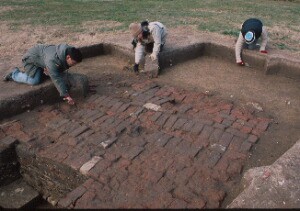
In 1996, JPPM began
offering its Public Archeology Program. Each summer,
volunteers are given the opportunity to assist Park
archeologists in the excavation of actual sites. The
public is invited to help excavate or screen for
artifacts, or to just watch the work in progress. During
the rest of the year, there are opportunities to work in
the Maryland Archeological Conservation Lab, or to
participate in occasional weekend digs. Lab experiences
include washing, labeling, counting, and identifying
artifacts, assisting in their conservation, or entering
data into a computer.
|